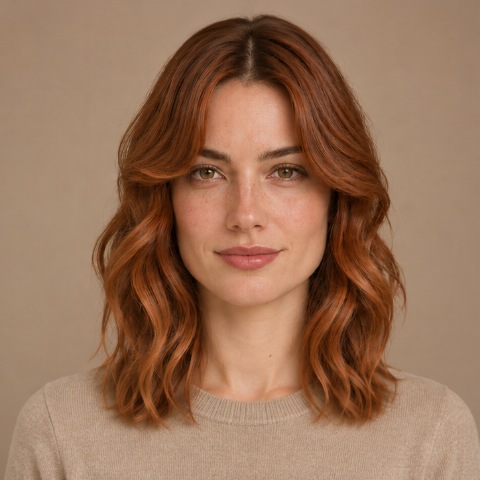
 Editorial inspiration
Also in: Medium length for women
A NEW POSSIBILITY
Blunt bangs
A full fringe creates a straight line across the forehead without changing the main cut.
- Talk to your stylist about
- Check where your fringe falls when dry, especially near a cowlick.
- Living with the look
- The fringe can need trims between regular haircuts.
- A helpful reality check
- A preview cannot predict how your hair will fall, feel or grow. Use it to discuss length and shape, alongside your texture and routine.
What defines Blunt bangs?
Blunt bangs make a continuous line across the forehead. Their width and density affect how strongly that horizontal line frames the eyes.
What to look for from the front, side and back
Check where the edge falls in relation to the brows and where it ends at the temples. In profile, see how far the fringe sits forward of the face.
What to confirm with your stylist
Agree on the dry fringe length and where the outer corners should stop. Ask how much hair needs to come forward to get that density.
Compare Blunt bangs with nearby styles
- Curtain bangs
Blunt bangs form a continuous line across the forehead. Curtain bangs open in the center and taper toward the sides.
- Wispy bangs
Wispy bangs leave visible gaps and a soft edge. Blunt bangs use a denser, continuous line across the forehead.
- Hime cut
Both can have a full fringe. The hime cut adds blunt jaw-length side panels, while the blunt-bangs preset leaves a more continuous outline through the sides.
Questions about Blunt bangs
Can I start with a less dense fringe?
Ask to bring forward a smaller section of hair and show how much forehead you are comfortable leaving visible.
KEEP EXPLORING
All hairstyles Compare related styles.
Editorial inspiration Editorial inspiration
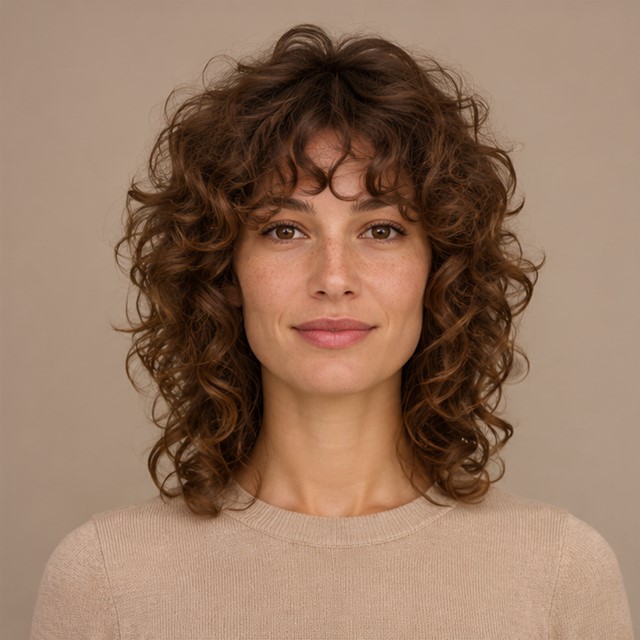 Editorial inspiration